
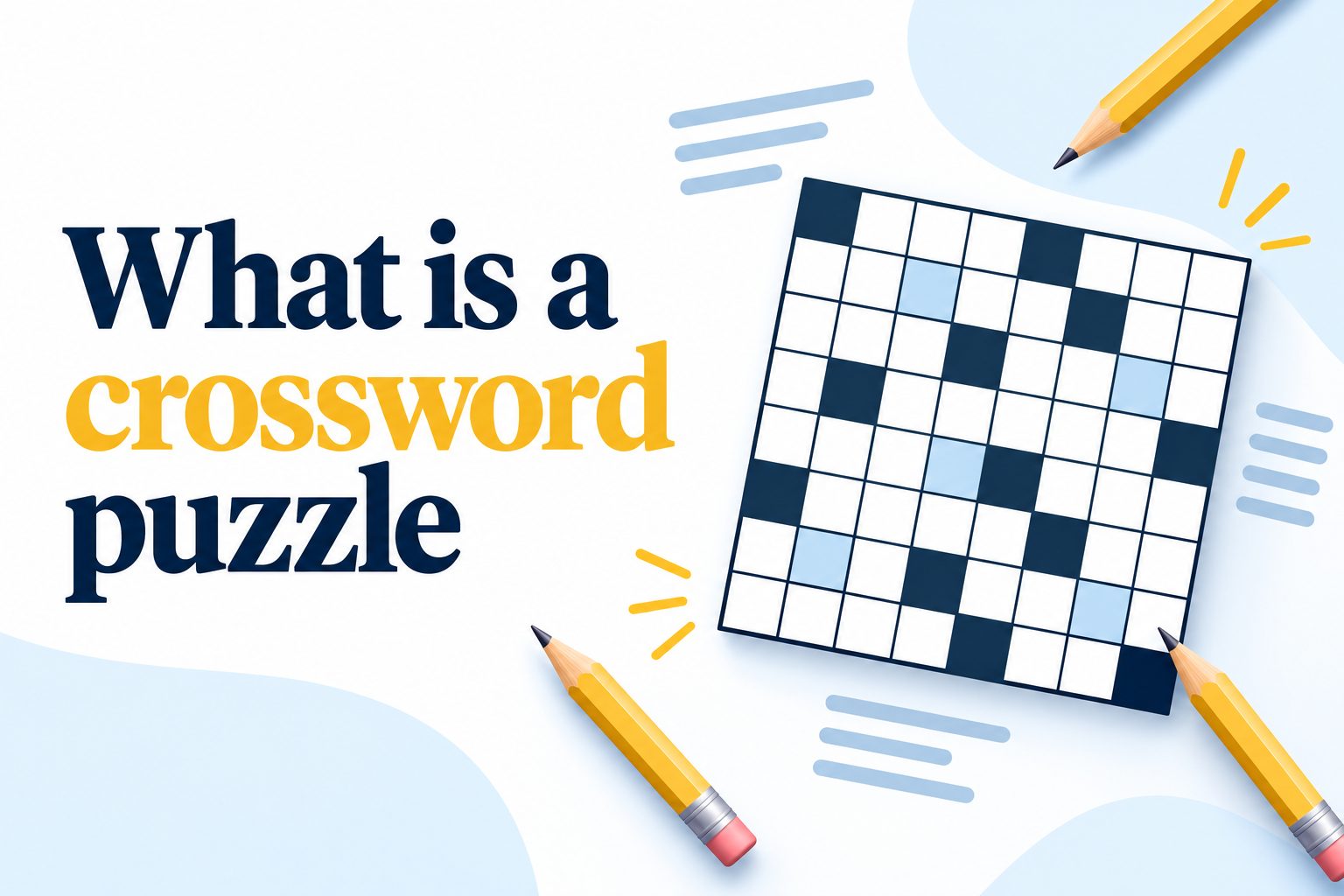
A crossword puzzle is a word game built around a grid of white and black squares, where players solve clues and enter answers that cross each other. Each correct word supports other answers by sharing letters, turning a collection of clues into one connected challenge.
People enjoy crosswords because they combine language, logic, memory, and pattern recognition. A puzzle can be a quick daily break, a difficult mental workout, or a social activity shared with friends and family.
This guide explains how crossword puzzles work, why they remain popular, how to solve them more effectively, and what beginners should know before tackling a grid.
A standard crossword grid contains numbered starting squares. The numbers match clues listed in two groups: Across for answers that run from left to right, and Down for answers that run from top to bottom.
Black squares separate answers and create the puzzle’s pattern. White squares hold letters, and many white squares belong to both an Across answer and a Down answer. Those crossings give solvers useful confirmation.
Clues vary widely in style. Some are direct definitions, while others rely on abbreviations, wordplay, common phrases, trivia, or a playful change in meaning. The difficulty often comes from recognizing the clue style as much as knowing a fact.
A well-made crossword has entries that fit the grid exactly and clues that match their answers fairly. The best puzzles offer a balance of accessible words, satisfying discoveries, and a few moments that make the solver think differently.
Crosswords appear in newspapers, books, apps, classrooms, and puzzle competitions. Although formats have changed, the basic appeal is unchanged: every solved answer makes the remaining grid a little clearer.
How Does A Crossword Puzzle Work?
1. Read The Grid Pattern
Before solving, look over the grid. Notice short entries, long entries, and areas with many crossings. A short answer can sometimes be guessed from a simple clue, while a longer answer may reveal the theme or central idea of the puzzle. The pattern helps you decide where an early answer may unlock several others.
2. Match Numbers To Clues
Every answer begins in a numbered square unless it continues from a previously numbered start. Find the matching number in the Across or Down clue list, then check the number of empty squares available. Answer length is an important clue because it rules out many otherwise possible words.
3. Fill In Across Answers
Across clues usually provide an easy way into a crossword because the answers are read in the same direction as normal text. Start with clues you know immediately, especially straightforward definitions, familiar names, or obvious phrases. Do not worry about filling the grid in order.
4. Use Down Crossings
Once an Across answer is entered, its letters become hints for Down answers that intersect it. Even one or two confirmed letters can make a difficult clue much easier. This crossing system is the defining feature of a crossword puzzle and rewards steady, connected progress.
5. Watch For Clue Signals
Certain punctuation and wording can signal that a clue is not literal. A question mark often suggests a pun or surprising interpretation, while words such as “briefly” or “for short” may indicate an abbreviation. Verb tense, plural form, and quotation marks can also guide the expected answer.
6. Check Letter Consistency
When two answers cross, the shared square must contain the same letter for both words. If the letter does not fit, revisit the clue instead of forcing an unusual spelling. Consistency checks prevent one uncertain guess from causing a chain of wrong answers across the puzzle.
7. Review The Completed Grid
A finished crossword should feel coherent: every clue should match its answer, every square should be filled, and no crossing should conflict. Read back through uncertain entries before declaring success. This final review is especially helpful when a clue uses a less familiar meaning or a cultural reference.
Why Are Crossword Puzzles Important?
1. They build active vocabulary by exposing solvers to synonyms, idioms, spelling patterns, and precise definitions.
2. They encourage flexible thinking because one clue may call for a literal answer, a shortened form, a pun, or a phrase.
3. They provide a low-pressure way to practice focus, since solving usually requires attention without demanding a large block of time.
4. They can support learning in classrooms by reinforcing subject vocabulary, historical terms, scientific concepts, and reading comprehension.
5. They create satisfying feedback because each correct crossing confirms progress and helps reveal the next answer.
6. They are widely accessible, with simple beginner grids and advanced themed puzzles available for different ages and skill levels.
7. They offer a screen-free or low-distraction pastime that many people can enjoy as part of a daily routine.
Benefits Of Solving Crossword Puzzles
- Vocabulary Practice: Crosswords regularly introduce alternative meanings, less common words, and useful spelling patterns. Looking up an unfamiliar answer after solving helps turn a temporary guess into lasting knowledge.
- Memory Exercise: Many clues ask solvers to recall names, places, sayings, and facts. Repeated retrieval can make familiar information easier to access later without feeling like formal study.
- Pattern Recognition: Solvers learn to notice common endings, letter combinations, abbreviations, and clue conventions. These patterns make future puzzles quicker to approach while still leaving room for creative reasoning.
- Problem-Solving Skills: A crossword encourages people to break a large task into smaller decisions. One answer leads to a letter, the letter leads to another answer, and gradual progress resolves the whole grid.
- Relaxation And Routine: For many people, a short puzzle offers a calm mental reset. It can become a pleasant morning, commute, or evening habit that replaces passive scrolling with focused play.
- Conversation Starter: Crosswords can be solved collaboratively, making them useful for families, classmates, and friends. Discussing clues often leads to shared memories, useful explanations, and a more enjoyable solving experience.
How Can Beginners Solve Crosswords Better?
1. Start With Easy Clues
Begin with clues that feel certain rather than chasing the hardest entry first. Direct definitions, common expressions, and very short factual answers are often good starting points. Early certainty creates reliable crossing letters, which reduce the amount of guessing required in tougher parts of the grid.
2. Solve In Any Order
A crossword does not need to be completed from top to bottom or clue one through clue fifty. Move around freely and return to blocked areas later. This approach keeps momentum high and lets newly filled letters change a difficult clue into an obvious one.
3. Use The Answer Length
Count the available squares before committing to an answer. A clue may suggest several related words, but the grid length often identifies the right one. Pay close attention to whether the clue is singular, plural, past tense, or phrased as an abbreviation.
4. Leave Uncertain Guesses Lightly
If an answer seems likely but is not confirmed, treat it as provisional. Mentally mark it as uncertain or use a light note if your puzzle format allows it. A flexible approach is better than building many later answers around one attractive but incorrect guess.
5. Learn Common Crossword Language
Crossword constructors often use recurring clue ideas, such as “for example,” “perhaps,” “briefly,” or references to a word’s first or last letter. Learning these conventions is not cheating; it is learning the language of the puzzle and becoming a more confident solver.
6. Break Down Long Clues
Longer clues can look intimidating, but they often point to a familiar phrase or a simple relationship between words. Identify the most important noun, verb, or unusual phrase in the clue, then test possibilities against the crossing letters instead of trying to solve everything at once.
7. Check Instead Of Forcing
When an answer creates awkward letters in several crossings, pause and reconsider it. Good puzzles are designed to be solvable through fair clues and consistent crossings. Re-reading the clue with fresh eyes is usually more productive than inventing a rare spelling to preserve a guess.
A crossword puzzle is more than a grid of clues and letters. It is a connected word challenge that asks players to combine knowledge, reasoning, and patience until every crossing makes sense.
The format works because it welcomes different solving styles. Beginners can enjoy simple clues and steady progress, while experienced solvers can seek out themes, wordplay, and difficult vocabulary.
The most useful habit is to start with certainty, use crossing letters carefully, and remain willing to revise an answer. With practice, the clues become easier to read and the process becomes more rewarding.
FAQs About Crossword Puzzles
What is a crossword puzzle?
A crossword puzzle is a word game in which answers are entered into a grid based on written clues. The answers run Across and Down, and they share letters where they intersect. Solvers use clue meanings, answer length, and crossing letters to complete every open square.
What is the difference between Across and Down clues?
Across clues lead to answers written from left to right in the grid. Down clues lead to answers written from top to bottom. A single white square can belong to one Across answer and one Down answer, so the letter in that square must work for both.
Are crossword puzzles good for beginners?
Yes, crossword puzzles can be very beginner-friendly when the grid and clue style match the solver’s level. Starting with smaller puzzles, simpler vocabulary, and direct clues builds familiarity. As confidence grows, themed puzzles and more playful clues become easier to enjoy.
Why do some crossword clues use question marks?
A question mark often signals that the clue involves wordplay, humor, or an unexpected interpretation. The answer may not be a literal definition. It invites the solver to think about a phrase in a different way and check whether that reading fits the available squares.
How can I improve at crossword puzzles?
Practice regularly, start with clues you know, and use crossings to test uncertain answers. Pay attention to grammar, answer length, abbreviations, and repeated clue styles. Reviewing unfamiliar words afterward also helps you build the vocabulary and puzzle awareness needed for harder grids.
Do crossword puzzles always have one correct solution?
A properly constructed crossword is designed to have one intended answer for each clue and one complete solution for the grid. Some clues may seem to allow several words at first, but the grid length and crossing letters narrow the options until the intended entry is clear.