
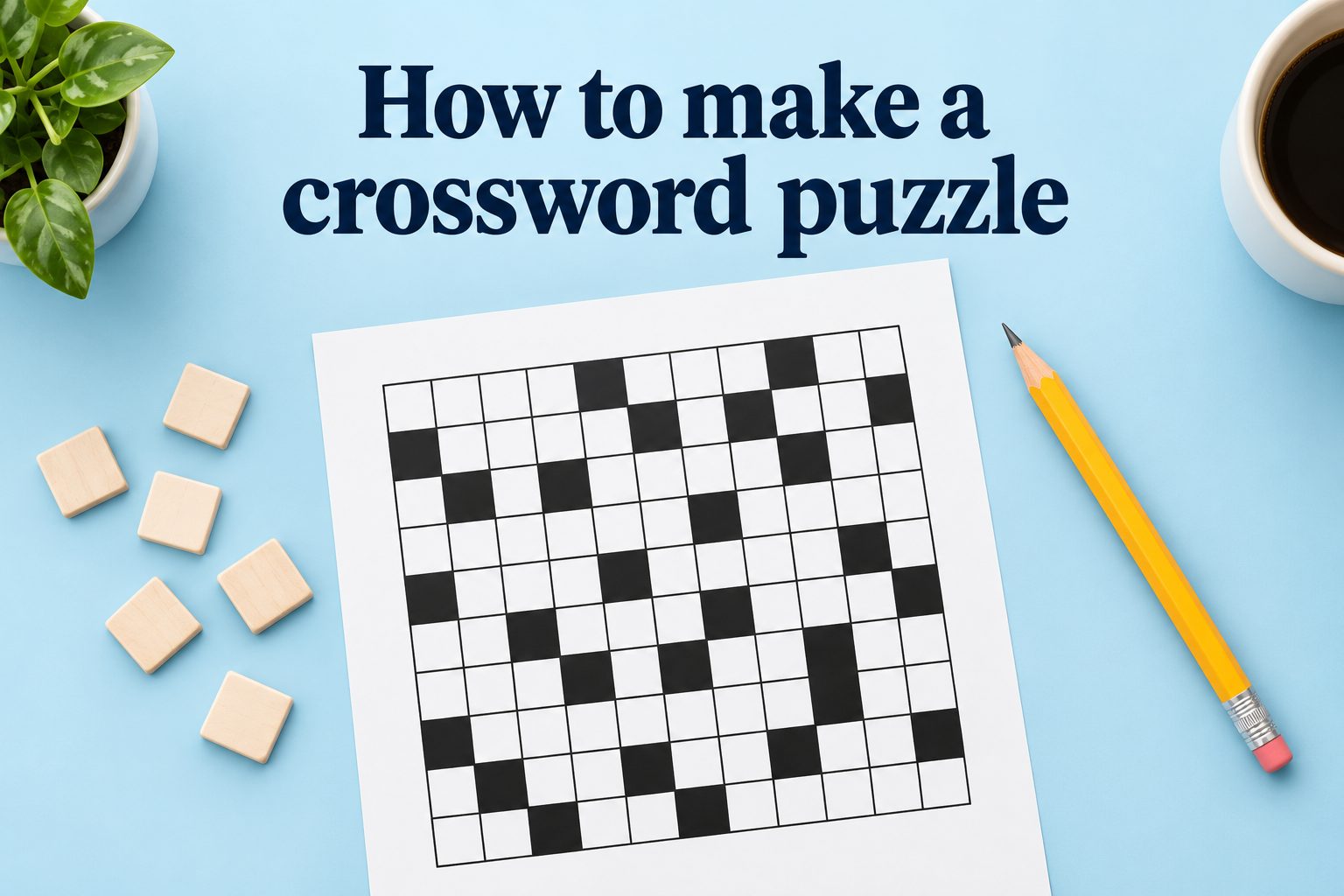
Learning how to make a crossword puzzle is a rewarding way to turn ideas, lessons, hobbies, or event themes into an activity people can enjoy together. A well-made puzzle feels simple to solve, but it combines planning, word choice, clue writing, and careful checking behind the scenes.
Crosswords can be used for quiet entertainment, classroom review, team-building, newsletters, party games, and personal gifts. You do not need advanced design skills to begin; you need a clear theme, a sensible word list, and patience with the grid.
This guide explains how to make a crossword puzzle from the first idea to the final review. It also covers useful tools, clue-writing techniques, common problems, and practical ways to make your puzzle fair and enjoyable for its intended solvers.
A crossword puzzle is a word game in which answers are placed across and down in a grid, sharing letters where they intersect. Each answer has a numbered clue that helps the solver discover the word.
The central goal is not merely to fit words into boxes. A good crossword creates satisfying connections between answers while giving solvers enough information to progress without guessing randomly.
Themes make crossword construction easier because they limit the possible answers. For example, a travel puzzle might include airport, passport, luggage, ticket, and journey, while a science puzzle might focus on planets, cells, energy, and experiments.
The difficulty should match the audience. Younger solvers and beginners usually benefit from familiar words and direct clues, while experienced solvers may enjoy wordplay, trivia, or more unusual vocabulary.
Whether you make the grid by hand or use a crossword generator, the same standards matter: accurate answers, clear clues, clean intersections, and a final test solve by someone who was not involved in creating it.
How Do You Make A Crossword Puzzle?
1. Choose A Clear Purpose
Start by deciding why you are making the crossword puzzle and who will solve it. A classroom revision activity, a birthday game, and a newspaper-style challenge need different vocabulary and clue difficulty. This decision guides every later choice, including the theme, grid size, tone, and final format.
2. Select A Focused Theme
Pick a theme that gives you enough related words without becoming too broad. Good themes include a season, a school subject, a favorite book genre, a local event, or a hobby. A focused theme makes the puzzle feel connected and helps solvers anticipate the kind of knowledge they need.
3. Build A Strong Word List
Write down more potential answers than you expect to use. Include words of different lengths, then favor entries that are familiar, easy to spell, and relevant to the theme. Longer words are useful anchors because they create more opportunities for other answers to cross them in the grid.
4. Remove Weak Or Awkward Entries
Review the list before drawing the grid. Remove obscure abbreviations, confusing spellings, duplicate concepts, and terms that only make sense with a long explanation. An answer should be worth solving on its own and should allow a clue that is accurate, concise, and fair.
5. Place The Longest Answers First
Put your strongest long answer near the middle of the grid, then add other long entries where shared letters create natural crossings. Avoid forcing every word into place immediately. Leaving open space gives you flexibility and usually leads to a cleaner, more balanced crossword layout.
6. Add Shorter Connecting Words
Use shorter answers to link longer entries and fill gaps in the puzzle. Check every crossing letter carefully as you work, because one incorrect placement can create several bad answers. If a fill word feels unnatural or requires an overly vague clue, replace it instead of forcing it to remain.
7. Number And Test The Grid
Once the grid is filled, number each starting square from left to right and top to bottom. Write the across and down clues in the same order, then solve the puzzle yourself from a blank copy. A separate test solver is especially valuable because they will notice unclear clues and hidden assumptions.
What Makes A Crossword Puzzle Enjoyable?
1. A clear theme gives solvers a helpful mental frame and makes the answers feel connected rather than random. It also makes the finished puzzle more memorable.
2. Fair clues give enough direction for the intended audience. They may be clever, but they should still point to one reasonable answer when paired with the letters already filled in.
3. Useful crossings provide confirmation. When answers share letters correctly, a solver can use progress in one direction to unlock another without feeling trapped.
4. Varied answer lengths create rhythm. A grid made entirely of tiny words can feel flat, while a few longer entries give the puzzle personality and structure.
5. A balanced challenge encourages persistence. Solvers should be able to make early progress, face a few satisfying pauses, and finish with confidence rather than frustration.
Key Crossword Puzzle Design Tips
- Keep The Grid Readable: Use a simple square grid with enough white space and clearly marked blocked cells. A tidy layout helps solvers focus on clues rather than deciphering the page.
- Match Words To Your Audience: Choose language your readers are likely to know. Specialized terms can work when the puzzle is educational, but the clues should give appropriate context.
- Prefer Natural Phrases: Use real words and familiar expressions whenever possible. Avoid strange fragments, forced abbreviations, and letter combinations that do not feel like meaningful answers.
- Write One Clear Clue Per Answer: A clue should describe the answer accurately and avoid giving away a different word with the same meaning. Read every clue aloud to spot vague wording.
- Vary Clue Styles Carefully: Mix direct definitions, simple facts, fill-in-the-blank clues, and light wordplay when the audience can handle it. Variety keeps the solving experience lively without making it inconsistent.
- Check Spelling And Facts: Verify every answer, proper name, date, and subject-specific detail before sharing the puzzle. Accuracy builds trust and prevents a correct solver from being marked wrong.
Common Crossword Puzzle Mistakes To Avoid
1. Making The Theme Too Broad
A theme such as general knowledge can produce a scattered word list with no clear identity. Narrow the focus to something more useful, such as garden plants, space exploration, or kitchen tools. A defined topic helps you choose better answers and makes clues easier for solvers to interpret.
2. Using Words Only To Fill Space
Do not keep an entry simply because it completes an empty corner of the grid. Random initials, awkward fragments, and obscure short forms can make a crossword feel unfair. Rearrange the area or remove a weaker answer until the fill reads like language people actually recognize.
3. Writing Clues That Are Too Vague
A clue such as “thing” or “place” gives almost no useful direction, especially before crossing letters are known. Add a category, context, or specific characteristic. Clear clues are not necessarily easy; they simply give solvers a logical path toward the intended answer.
4. Repeating The Same Clue Pattern
If every clue is a dictionary-style definition, the puzzle can become monotonous. Add variety through examples, gentle wordplay, or theme-related references, but keep the difficulty consistent. A mix of clue styles creates a more engaging solving experience without making the puzzle unpredictable.
5. Ignoring The Order Of Difficulty
Placing the hardest clues at the beginning can discourage new solvers before they have any crossing letters. Include a few accessible entries throughout the puzzle so people can build momentum. Early success makes difficult clues feel like an interesting challenge rather than a dead end.
6. Forgetting To Test Solve
Creators often know the intended answers so well that unclear clues seem obvious to them. Give the completed crossword to someone from the target audience and ask them to solve it without help. Their questions reveal where a clue, answer, or grid crossing needs revision.
7. Treating Software As The Final Editor
A crossword generator can arrange words quickly, but it cannot always judge whether an entry is natural or whether a clue is fair. Review all generated results manually. Use the tool for speed, then rely on human judgment for quality, clarity, and audience fit.
Making a crossword puzzle begins with a clear purpose, a focused theme, and a thoughtful word list. From there, careful grid placement and accurate clues turn separate ideas into a satisfying game.
The strongest puzzles respect the solver’s time. They use familiar language when appropriate, offer helpful crossings, and create challenge through smart clueing rather than confusion.
Take time to test the finished grid before sharing it. Small revisions to an answer, clue, or crossing can greatly improve the final experience for everyone who solves it.
FAQs About Making A Crossword Puzzle
How many words should a beginner crossword puzzle have?
A beginner puzzle can work well with about 10 to 20 answers, depending on the grid size and audience. Start with a small, focused puzzle so you can pay attention to clue quality and crossings. A shorter puzzle is easier to test, revise, and complete successfully.
Can I make a crossword puzzle without special software?
Yes, you can make a crossword puzzle with graph paper, a pencil, and a simple word list. Place longer answers first, add crossing words, black out unused squares, and number each starting cell. Software is convenient, but it is not required for a clear and enjoyable puzzle.
What is the best grid size for a simple crossword?
A small grid, such as 9 by 9 or 11 by 11 squares, is a practical starting point for a simple crossword. It leaves room for several interesting answers without becoming difficult to manage. Choose a larger grid only when your word list and audience need more space.
How do I write fair crossword clues?
Write clues that lead logically to the answer for your intended audience. Include enough detail to narrow the possibilities, especially for short words. Avoid clues that rely on private knowledge, unclear wording, or multiple equally likely answers. Test solving is the best way to check fairness.
Should all crossword answers match one theme?
Not every answer must be themed, but the main entries should clearly support the chosen topic. Smaller connecting words may be general vocabulary, especially in a compact grid. The important point is that the theme feels intentional and gives solvers a recognizable thread through the puzzle.
How can I make a crossword puzzle more difficult?
Increase difficulty gradually by using less direct clues, longer answers, more challenging vocabulary, or gentle wordplay. Do not make it harder by using inaccurate clues or obscure fill words. A good difficult crossword remains solvable through reasoning, crossings, and knowledge appropriate to its audience.